
AI Solutions Background
AI SOLUTIONS FOR BUSINESS

AI Development & Integration for Your Business Software

Turn the information your team reads every day into work your software can help complete. Moltech's AI integration services connect document processing, internal search, and repetitive workflows to existing applications. We also help businesses develop a new AI solution when the workflow needs its own application.

Whether you are improving a business portal or planning a new product, start with one task: what comes in, what your team needs to produce, and what should be checked before the next step.
Example workflow
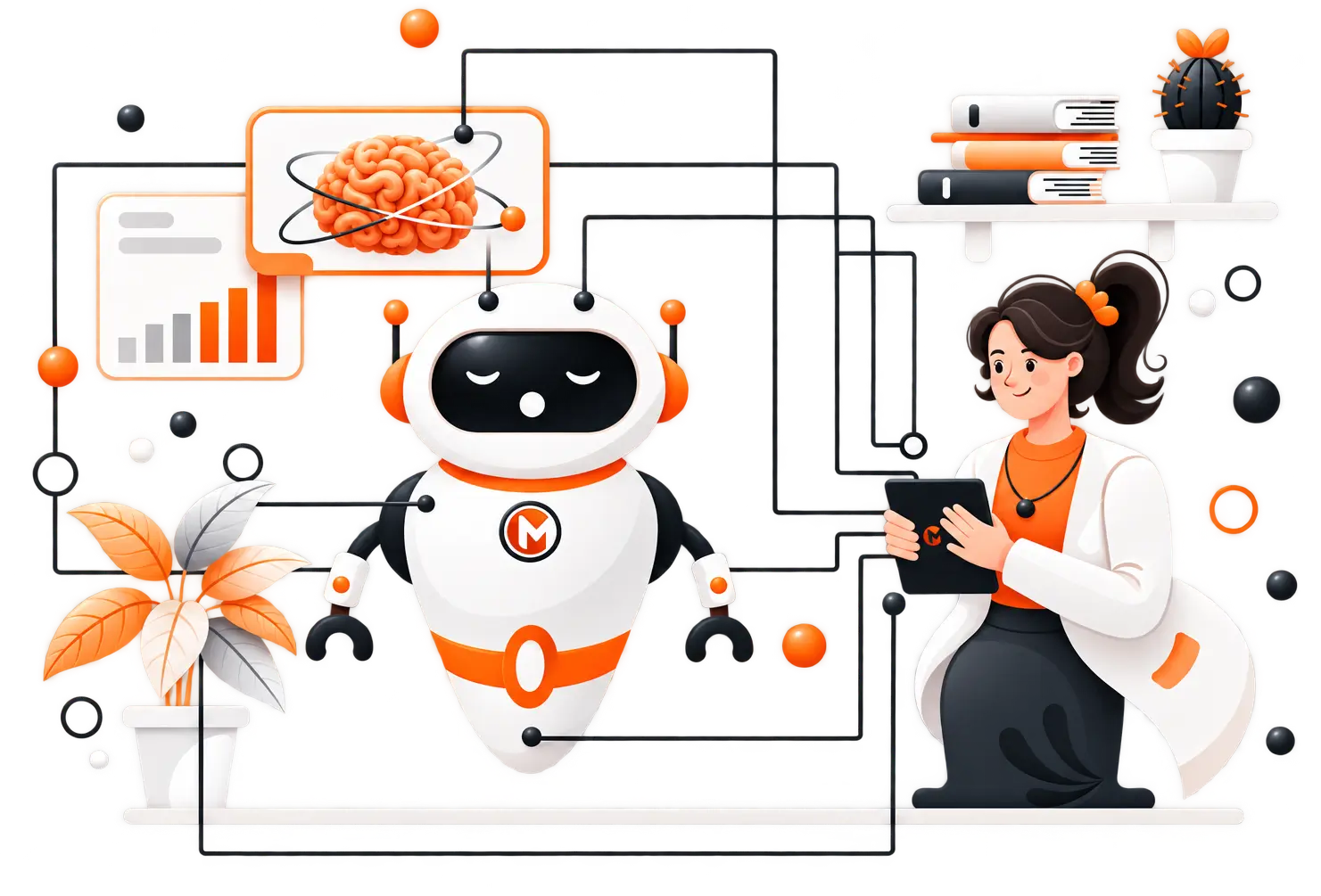
Document → Review → Record
Step 01Incoming Data

Document

Invoices, PDFs, emails, forms, or unstructured business documents.

Step 02AI Analysis

Review

Key field extraction, business rule validation & human oversight.

Step 03Connected Systems

Record

Approved data synced directly into your portal, ERP, CRM, or database.

Why AI Is No Longer Optional
What AI Solutions Mean

What Does an AI Solution Do for Your Business?

An AI solution combines a model's ability to interpret information with the software, data, and rules your business uses. It might read a document, identify the details your team needs, find relevant instructions, or prepare a first draft. The application then puts that result where someone can use it such as a candidate record, a service request, or a review screen.

For example, reading an invoice is only one part of the job. A useful application also checks the extracted information, identifies missing details, and prepares a record for the accounts team. AI handles the interpretation; defined rules and people control what happens next.

Not every repetitive task needs AI. When a process follows consistent rules, conventional automation may be the simpler option. The right approach depends on the information involved and the decisions your team needs to make.

WHAT CUSTOMERS CAN BUILD

What Could Your Team Build?

These examples show possible project directions. The right scope depends on your data, existing applications, and review requirements.

Turn Documents into Records Your Team Can Review

Invoices, forms, and other documents often arrive in different layouts. An AI-assisted intake tool can extract agreed fields, prepare a draft record, and highlight missing or inconsistent information. Your team reviews exceptions before approved data moves into the destination application. A sensible first project focuses on one document family and measures processing time and corrections required.

Prepare Quote Requests for Your Sales Team

When customers send product requests by email or attachment, sales staff may spend time organizing quantities, specifications, and product references. A custom workflow could extract those details, suggest matches from an approved catalogue, and prepare a quotation draft. Unclear matches go to a salesperson, while prices come from your approved pricing source. The salesperson reviews the quotation before it is sent.

Help Employees Find Answers in Company Documents

An internal knowledge assistant can help employees search approved manuals, policies, and operating procedures. Instead of returning an unsupported answer, it should point to the source material and make gaps visible. The solution needs access controls, a way to keep documents current, and a clear response when the available information does not answer the question.

Organize Incoming Requests and Draft Responses

A shared inbox can contain support questions, order updates, and requests that belong to different teams. An AI-assisted workflow could identify the request type, extract relevant details, and suggest a destination or response. Staff can review uncertain cases and approve messages before sending. The first goal is a more manageable queue, with fewer manual sorting steps and clearer ownership.

Add an AI Feature to Your Customer Product

A new or existing SaaS product may benefit from document intake, record summaries, or an assistant that works with the user’s permitted information. The feature needs more than a model connection: it also needs a clear interface, tenant access controls, usage limits, and behavior for incomplete or unreliable results. Start with a feature users can evaluate on a real task.

AI DECISION MATRIX

Where Could AI Help Your Business?

Select the situations that match your business. See a suggested starting point for improving your existing software, building a new solution, or preparing your data first. You can view your result without submitting your contact details.

Q1

Question 1 - Where are you starting?

Select one option.
Q2

Question 2 - What would you like to improve?

Select all that apply.
Q3

Question 3 - What information can you work with?

Select one option.
REAL MOLTECH PROJECT

AI Inside a Moltech Recruitment Application

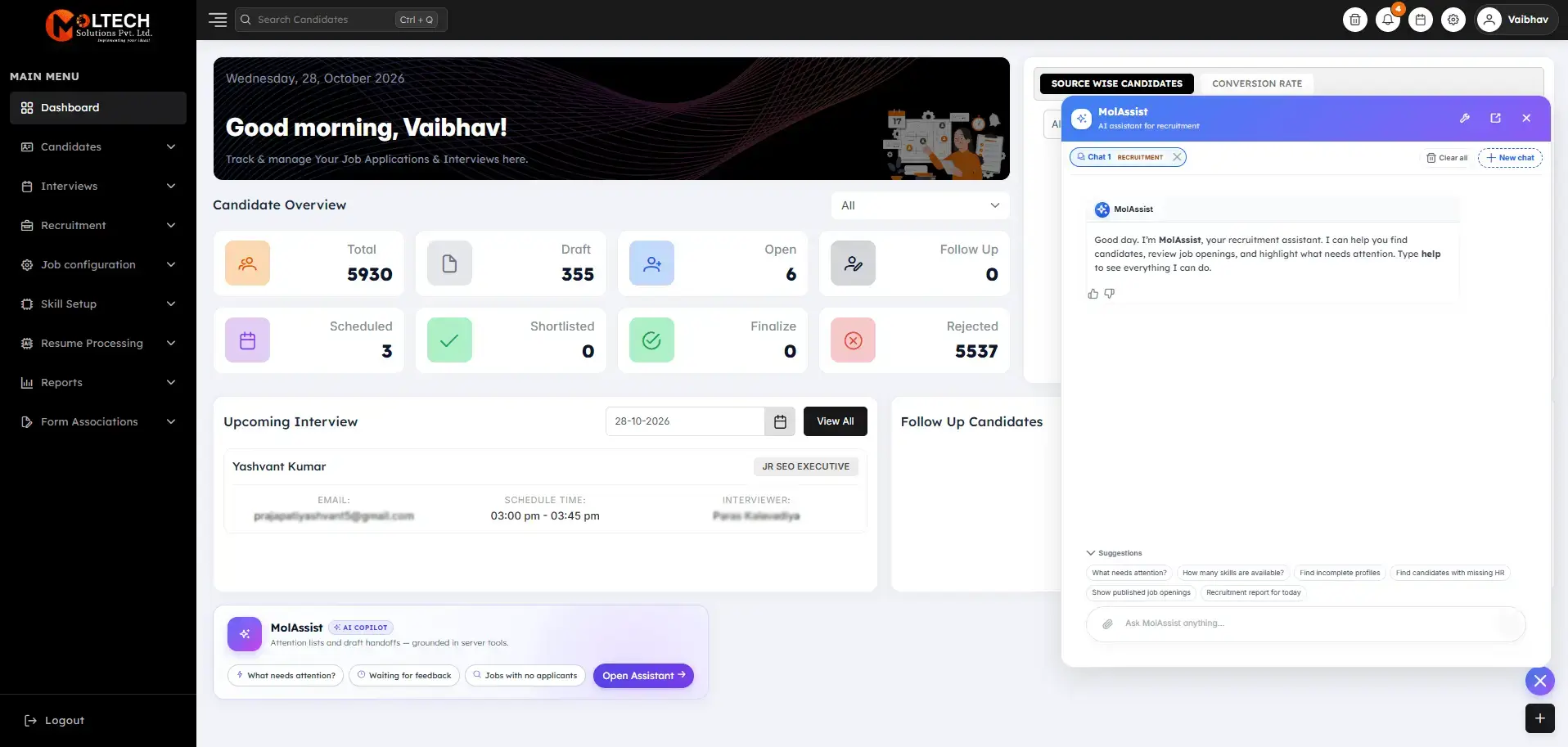
Moltech built a recruitment portal with a resume-parsing feature that extracts information and fills candidate records. The feature sits within a broader application for managing candidates, interview stages, and feedback.

The project combines .NET, React, SQL Server, and Python. It provides a concrete example of connecting an AI-assisted function to a business application rather than leaving its output in a separate tool.

Architecture & Tech Stack:
.NETReactSQL ServerPython
/recruitment-portal
Live System
Moltech HRMS Recruitment Portal Dashboard with AI Resume Parsing
AI Resume ParsingAuto-fills candidate profiles
EXISTING SOFTWARE OR NEW APPLICATION

Improve What You Have-or Build What Is Missing

Whether integrating AI capabilities into current enterprise workflows, launching a standalone product, or fixing data readiness first, we engineer the right foundation for sustainable impact.

Add AI to an Existing Application

Enhancement

If your current software already supports the main workflow, the project may focus on adding a capability within it. That could mean a document upload, a review queue, an answer panel, or a draft record. The first technical questions concern available APIs, database access, user permissions, and how approved results reach the right record.

  • Document upload & review queue
  • APIs, database access & permissions
  • Approved results to destination record

Develop a New AI Application

Greenfield

A new application may make sense when the workflow has no suitable home or you are creating a customer product. The scope includes the screens, user roles, data structure, integrations, and AI behavior needed to complete the task. A focused first version lets users test the workflow before you expand it.

  • Dedicated user screens & role permissions
  • Data architecture & model integrations
  • Focused first version for live testing

Prepare the Data and Process First

Data First

If source documents are outdated, records conflict, or nobody owns the approval step, adding AI can carry those problems forward. The first phase may need to organize information, connect systems, or define the review process. That work creates a clearer foundation for deciding whether an AI feature will be useful.

  • Clean up outdated & conflicting records
  • Connect & synchronize existing systems
  • Define clear ownership for review steps

Looking for custom software development?

From bespoke web platforms to scalable enterprise applications, explore our full software engineering services.

How the Project Works

Start with One Workflow and Test It Properly

Our AI Solutions Process
1

Define the Task and Its Boundaries

Identify what starts the work, the information available, the output needed, and who approves it. Agree what the first version will handle and which exceptions will stay with your team. This makes the project easier to estimate and evaluate.

2

Check the Data and Integration

Review representative samples and the systems involved. Confirm how information can be accessed, which users may see it, and where outputs should go. Include difficult examples early, such as incomplete documents or conflicting records.

3

Build and Evaluate a Pilot

Test a limited workflow against agreed examples. Compare its results with the current process, including corrections, handling time, and operating cost. Decide whether the evidence supports expanding the solution, revising it, or keeping a simpler approach.

4

Release with Review and Monitoring

Plan the rollout around user review, visible failures, and clear ownership. Agree how the application will be maintained as documents, business rules, and model services change. Define the support scope before release.

Data and Human Review

Know What Happens to Your Data—
and When a Person Steps In

Data & Environment

Data Access, Environment & Governance

A project plan should identify what information the AI can access, whether any data leaves your environment, and which service providers are involved. Hosting, retention, permissions, and logging need to match the agreed requirements. These choices are assessed for each project; they are not automatic guarantees attached to every AI tool.

Key Planning Factors:
  • Information access scope & environment boundaries
  • Hosting, retention & third-party service providers
  • Role-based permissions & activity logging
Human Oversight

Uncertainty Handling & Approval Boundaries

The plan should also define what happens when the system is uncertain or unavailable. Depending on the workflow, it may ask for missing information, send a record for review, or pause an action. For messages, quotations, and record changes, agree the approval boundaries before enabling automation.

Oversight & Safety Checks:
  • Fallback protocols when uncertain or service is down
  • Exception queues & missing information requests
  • Clear sign-off thresholds for records & messages
USA and Canada

Discuss Your US or Canadian Business Workflow with Moltech

Moltech Solutions Inc. is based in Plano, Texas. For businesses in the United States and Canada, the starting conversation can focus on your current software, the task you want to improve, and the people who will use the result. Share any requirements for working hours, hosting location, document languages, and internal approvals so they can be evaluated as part of the scope.

Start the Conversation
Headquartered in Plano, Texas

Working Hours

US & Canadian timezone alignment

Hosting Location

Tailored infrastructure & data residency

Document Languages

Regional multi-lingual workflow intake

Internal Approvals

Custom governance & sign-off boundaries

FREQUENTLY ASKED QUESTIONS

Do you have Questions About AI Development and Integration ?

Let's connect and discuss your project. We're here to help bring your vision to life with the right technology, team, and approach.

ExpertGuidance
TailoredSolutions
QuickSupport
FAQ Questions and Answers
LET'S WORK TOGETHER

Tell Us Which Task You Want to Make Easier

Describe the work your team repeats, where the information comes from, and what should happen next. Moltech can help you explore whether the next step is an AI feature, a new application, or better integration of the systems you already use.

Call us:+1-945-209-7691
Email:inquiry@mol-tech.us
Address:2000 N Central Expressway, Suite 220, Plano, TX 75074, United States
Connecting Continents, Empowering Businesses
Our branch offices ensure seamless support across the globe.
USA flagUSA
12
3
6
9
00:00
2000 N Central Expressway
Suite 220
Plano, TX 75074
United States
inquiry@mol-tech.us
+1-945-209-7691
Singapore flagSingapore
12
3
6
9
00:00
408 Joo Chiat Place
Singapore (428085)
inquiry@mol-tech.us
+65 8753 5833
Switzerland flagSwitzerland
12
3
6
9
00:00
Kirchmooshöhe 4
4800 Zofingen
inquiry@mol-tech.us
India flagIndia
12
3
6
9
00:00
5th Floor, 506,
Dwarkesh business hub
Opp. Visamo Society, Motera,
380005, Ahmedabad, Gujarat
inquiry@mol-tech.us
+91 81286 94374